
A boiler that keeps losing pressure can leave your home without reliable heating or hot water. If you regularly need to top up your boiler, the pressure drop could indicate a water leak, a problem with the expansion vessel or another fault within your central heating system.
Understanding why your boiler pressure keeps dropping can help you recognise the warning signs and decide when to call a qualified heating engineer. This guide explains the most common causes, what you can safely check and when professional boiler repairs may be necessary.
What Should Your Boiler Pressure Be?
Most domestic combination and system boilers operate at around 1 to 1.5 bar when the heating system is cold, although the correct pressure depends on the manufacturer and model.
When your central heating switches on, the pressure normally increases as the water heats up. A small change is expected, but a significant rise followed by a substantial drop may indicate a fault.
Check your boiler’s pressure gauge or digital display and compare the reading with the manufacturer’s instructions. If the pressure repeatedly falls below the recommended range, topping it up may provide temporary relief but will not necessarily solve the underlying problem.
Why Does My Boiler Keep Losing Pressure?
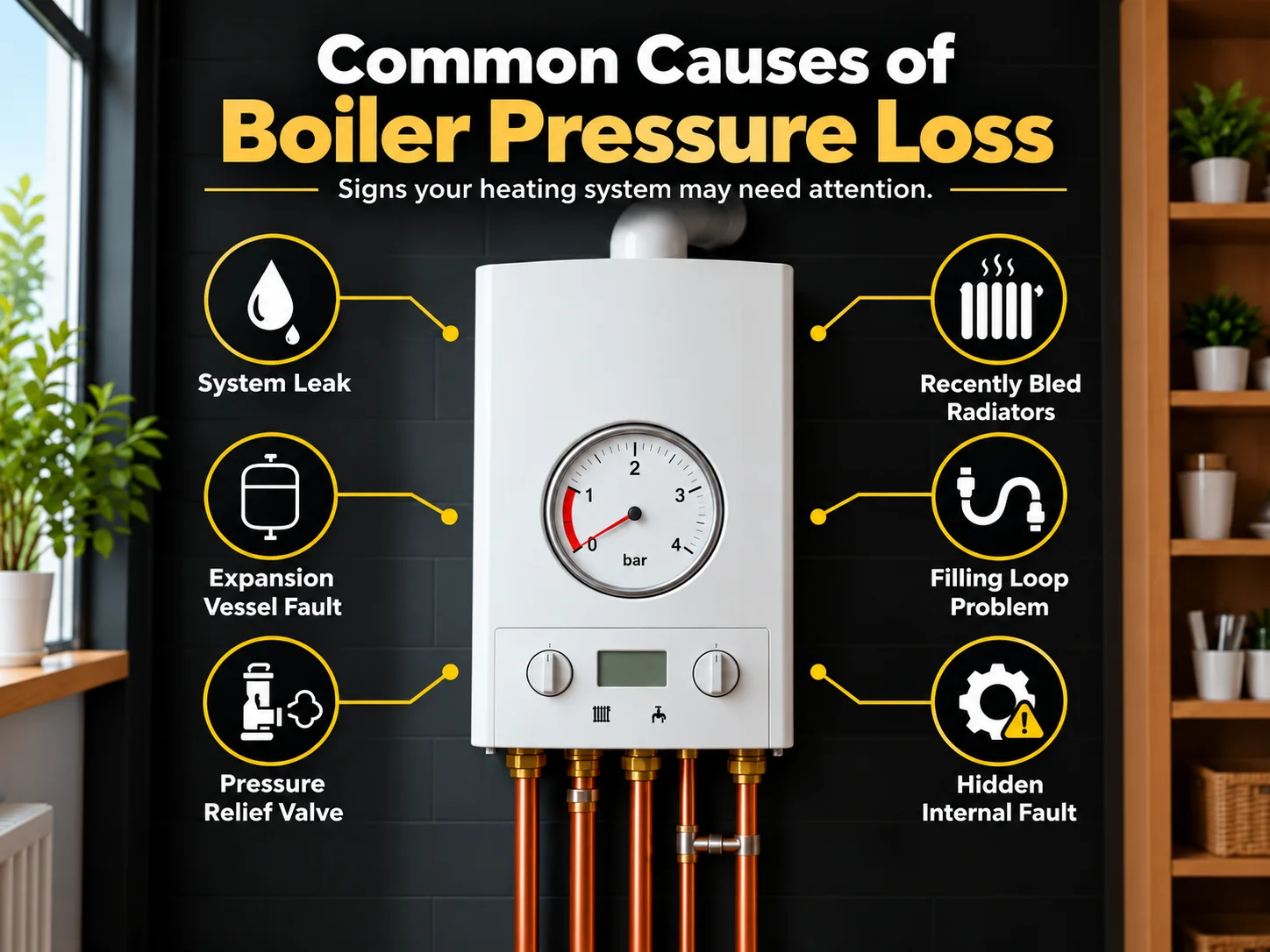
Several faults can cause boiler pressure to drop. Identifying the likely cause can help you understand what needs attention.
1. A Leak in Your Central Heating System
A leak is one of the most common reasons for repeated pressure loss. Even a small amount of escaping water can affect the pressure inside a sealed central heating system.
Leaks may develop around radiator valves, pipe joints, towel rails or sections of pipework. You might notice damp patches, discolouration on walls, water around a radiator valve or corrosion near a connection.
Not every leak is immediately visible. Pipework beneath floors or behind walls can conceal the source of the problem.
What to do: Check accessible radiators and visible pipework for signs of moisture. Do not remove flooring or boiler covers to investigate hidden leaks. If you suspect a leak or the pressure continues to fall, arrange an inspection with a qualified heating engineer.
2. A Faulty Expansion Vessel
The expansion vessel allows water in a sealed heating system to expand as it warms up. If the vessel loses its charge or develops a fault, the system may struggle to manage changes in water volume.
One common warning sign is a pressure gauge that rises significantly when the heating is running and then drops as the system cools. In some cases, the boiler may discharge water through its pressure relief valve, causing the pressure to fall afterwards.
What to do: Monitor the pressure when the heating is cold and when it is running, provided the boiler is operating normally. A qualified heating engineer can check the expansion vessel and determine whether it needs recharging or replacing.
3. A Pressure Relief Valve That Is Not Sealing Properly
The pressure relief valve is a safety component designed to release excess pressure from the heating system. If it becomes faulty or fails to close properly after releasing water, pressure can gradually decrease.
You may notice water escaping from the boiler’s external discharge pipe, which often terminates outside the property. However, water from this pipe can also indicate that the valve is responding to excessive system pressure rather than being faulty itself.
What to do: If you notice water discharging from the pipe, arrange a professional inspection. Do not block, cap or interfere with the discharge outlet, as this could compromise the safety of the system.
4. Radiators Have Been Bled Recently
Bleeding a radiator releases trapped air that can prevent it from heating evenly. However, removing air from the system can also reduce its pressure.
If your boiler pressure started dropping after you bled one or more radiators, this could explain the change. The pressure should be checked afterwards and adjusted according to the boiler manufacturer’s instructions.
What to do: Check the pressure gauge once the system has cooled. If the pressure is below the recommended level, follow the manufacturer’s instructions for repressurising the boiler, provided you are confident doing so. If the pressure continues to fall, another fault may be present.
5. A Problem With the Filling Loop
The filling loop allows water to enter a sealed central heating system when its pressure needs to be increased. If the filling loop is not operated correctly, its valves are faulty or a connection leaks, the system may not maintain the correct pressure.
A filling loop is not a permanent solution to recurring pressure loss. Repeatedly adding water without investigating the cause can allow an underlying fault to go unnoticed.
What to do: Check the manufacturer’s guidance and look for visible signs of leakage around accessible connections. If the filling loop is damaged or the pressure will not remain stable, ask a qualified heating engineer to inspect it.
6. A Hidden Leak or Internal Boiler Fault
Sometimes the pressure drops even though there is no obvious leak around radiators or visible pipework. Water may be escaping from concealed heating pipes or through a faulty internal component.
Internal faults can be difficult to identify without the appropriate equipment and technical knowledge. Attempting to inspect the inside of a boiler yourself can expose you to electrical, hot-water and gas-related hazards.
What to do: Arrange professional boiler repairs if the pressure continues to fall and the cause is unclear. An engineer can inspect the system, test relevant components and identify the source of the problem.
What Should You Do If Your Boiler Keeps Losing Pressure?
If you notice repeated pressure loss, follow these practical steps before deciding what to do next.
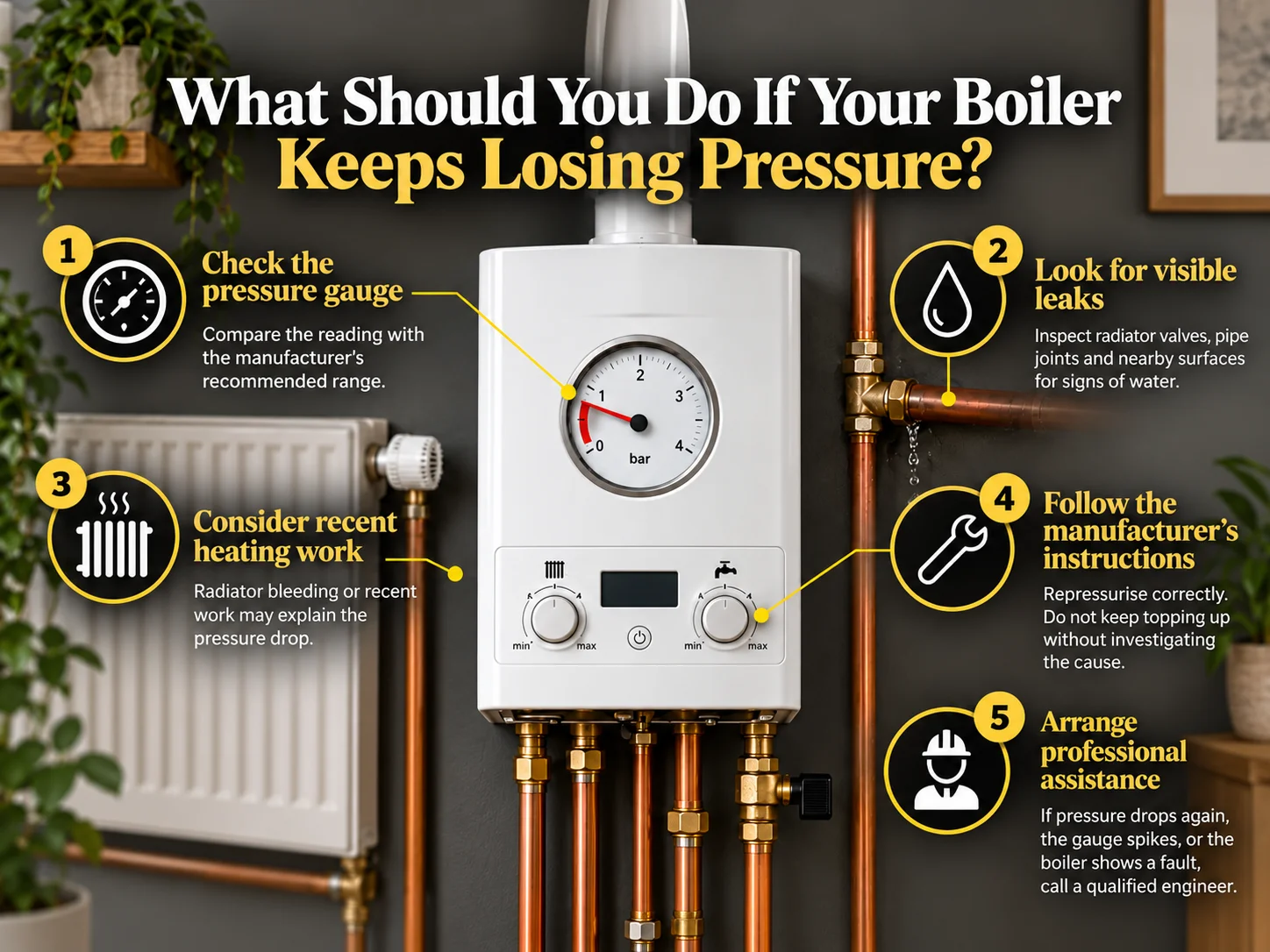
- Check the pressure gauge. Compare the reading with the manufacturer’s recommended range for a cold heating system.
- Look for visible leaks. Check accessible radiator valves, pipe joints and nearby surfaces for signs of water.
- Consider recent heating work. If you have recently bled radiators or had work carried out on the system, this may help explain the change in pressure.
- Follow the manufacturer’s instructions. If the boiler needs repressurising, use the approved procedure for your particular model. Do not repeatedly top up the system without investigating recurring pressure loss.
- Arrange professional assistance. If the pressure drops again, the gauge rises excessively, water is escaping or the boiler displays a fault, contact a qualified heating engineer.
If the boiler shows a fault or the pressure is outside its permitted range, follow the manufacturer’s safety instructions rather than continuing to operate it.
Can Low Boiler Pressure Affect Heating and Hot Water?
Yes. Low pressure can prevent some boilers from operating correctly. Depending on the model and the severity of the pressure loss, the boiler may display an error code, switch itself off or stop providing heating and hot water.
You might also notice that your radiators are not heating as expected. However, cold radiators and inconsistent hot water can have other causes, so low pressure should not automatically be treated as the only possible fault.
If your boiler repeatedly loses pressure or cannot maintain normal operation, a professional diagnosis can help establish whether the problem involves a leak, a faulty component or another heating system issue.
When Should You Call a Heating Engineer?
A single pressure drop after radiator bleeding may be straightforward to address. Repeated pressure loss, however, usually warrants further investigation.
Contact a qualified heating engineer if:
- You need to top up the boiler pressure regularly.
- The pressure rises sharply when the heating comes on.
- You notice water around radiators, pipework or the boiler’s discharge pipe.
- Your boiler repeatedly shuts down or displays a pressure-related fault.
- You cannot identify why the pressure keeps falling.
Do not remove the boiler casing or attempt to repair internal components yourself. If you smell gas, follow the relevant gas emergency procedure rather than treating the problem as an ordinary pressure fault.
Should You Repair or Replace a Boiler That Keeps Losing Pressure?
Repeated pressure loss does not automatically mean you need a new boiler. In many cases, the cause can be resolved by repairing a leaking connection, servicing a faulty component or addressing a problem with the expansion vessel or pressure relief valve.
The right decision depends on the condition of the boiler, the cause of the fault, the availability of replacement parts and the likely cost of further repairs.
If the boiler is older, has developed several faults or requires repeated repairs, it may be worth discussing replacement with a qualified heating engineer. A professional assessment can help you compare the practical benefits of repairing the existing boiler with installing a new heating system.
For homeowners considering a replacement, JH Plumbing & Heating Solutions provides boiler installation services to help determine a suitable system for the property’s heating and hot water requirements.
How JH Plumbing & Heating Solutions Can Help
If your boiler keeps losing pressure and the cause is not clear, JH Plumbing & Heating Solutions can help you identify the problem and determine the appropriate next steps.
Whether the issue involves recurring pressure loss, a suspected leak or a boiler that will not operate normally, arranging a professional assessment can help prevent unnecessary adjustments and identify faults that need attention.
Explore our heating breakdown services for help with heating problems, or contact JH Plumbing & Heating Solutions to discuss your boiler fault.
Frequently Asked Questions
Why does my boiler lose pressure every day?
Daily pressure loss may indicate a leak, a faulty expansion vessel, a pressure relief valve problem or another fault in the heating system. If you need to top up your boiler every day, arrange a professional inspection rather than repeatedly adding water.
Is it normal for boiler pressure to drop when the heating is off?
A small change in pressure as the system cools can be normal. However, a continuing or significant drop when the heating is off may indicate a leak or component fault. Compare the readings with the manufacturer’s guidance and seek advice if the pressure keeps falling.
Can a boiler lose pressure without a visible leak?
Yes. Water may escape through concealed pipework, or a faulty component may allow water to discharge without leaving an obvious puddle indoors. An engineer can investigate the system to locate the source of the pressure loss.
Should I keep topping up my boiler pressure?
You should not repeatedly top up a boiler without understanding why the pressure is falling. Follow the manufacturer’s instructions for any necessary adjustment, but arrange professional help if the problem returns.
Can bleeding radiators cause boiler pressure to drop?
Yes. Bleeding radiators releases air from the heating system and can lower its pressure. Check the gauge afterwards and follow the manufacturer’s instructions if the pressure needs adjusting.
Why does my boiler pressure rise when the heating is on and drop when it cools?
The pressure normally increases as the heating water warms up. A very large increase followed by a substantial drop may indicate an expansion vessel problem or water escaping through the pressure relief valve. A heating engineer can check both components.
Will low boiler pressure stop my heating from working?
It can. Some boilers shut down when the pressure falls below their operating range. Check the pressure and any displayed fault code, then follow the manufacturer’s instructions. If the boiler will not operate normally, seek professional assistance.
How do I know if my boiler needs repairing or replacing?
The decision depends on the cause of the fault, the boiler’s age and condition, repair requirements and future reliability. A qualified heating engineer can assess whether a repair is appropriate or whether replacement is worth considering.
Get Help With a Boiler That Keeps Losing Pressure
Repeated boiler pressure loss should not be ignored. Although a minor pressure adjustment may sometimes be sufficient, recurring drops can indicate a fault that needs professional attention.
JH Plumbing & Heating Solutions can help you investigate boiler problems and explore suitable repair or replacement options. Visit our heating breakdown or boiler installation service pages to find out more.